
Is Forearm Cooling an Occupational Heat Stress Control?
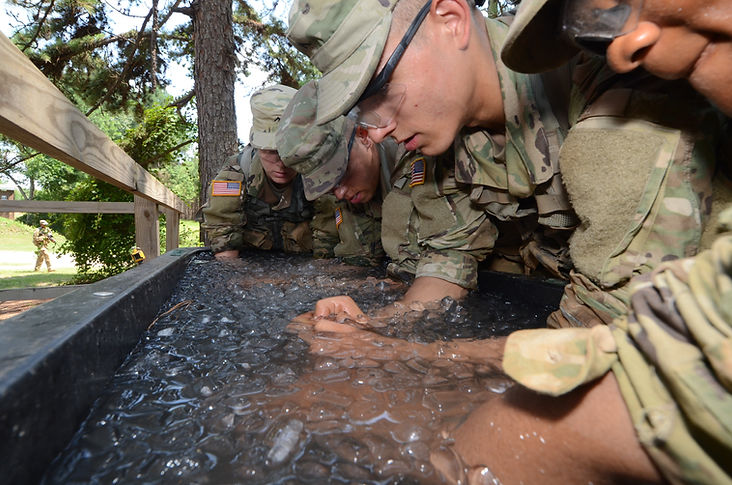
Figure 1. Forearm immersion by basic trainees at Fort Jackson, Columbia, South Carolina (Credit - Robert Timmons/U.S. Army)
Immersion of the forearms (Figure 1) is a cooling technique used predominantly in military and firefighting contexts. In conjunction with Dr Anthony Walker, we reviewed the core temperature cooling rates of forearm immersion, publishing our results in 2015. From the 12 studies reviewed, 10 - 24.9ºC (50 - 77ºF) forearm immersion yielded core temperature reductions of only 0.1 - 0.5ºC per 10 minutes, classifying this method as unacceptably slow (Table 1). We proposed the core temperature cooling rate classifications of Table 1 for time-limited firefighting operations, but they also apply to occupational settings where rest breaks are brief (up to 15 minutes) for commercial viability.
Table 1. Proposed rates of cooling for firefighting operations to allow for the rapid safe re-entry of firefighters to emergency incidents
Classification | Core Temperature Cooling Rate |
Ideal | >1.0ºC/10 mins |
Acceptable | 0.7-1.0ºC/10 mins |
Unacceptable | <0.7ºC/10 mins |
In 2016, a study by Yeargin and colleagues achieved a cooling rate of 1ºC per 10 minutes for 5ºC (41ºF) forearm immersion. Such a cooling rate significantly exceeded prior findings as it represented the first trial of water temperatures below 10ºC. So, is forearm immersion a viable workplace heat stress control? The answer depends on the immersion water temperature, tasks to be performed after cooling and logistical constraints.
Water Temperature
In addition to the 12 aforementioned studies reviewed in 2015, research continues to confirm the slow cooling rates for 10ºC or warmer forearm immersion (Nakamura et al., 2020; Iwahashi et al., 2023; Caballero et al., 2026). From these 15 studies, a total of 180 participants immersed their forearms in mean 15.0ºC (59ºF) water to lower their core temperature a mean of 0.35ºC per 10 minutes. It's probable that higher pre-treatment core temperatures would improve reported cooling rates (Brearley et al., 2023), but they are unlikely to approach acceptable cooling rates.
Task Performance
Evidence supporting forearm immersion is limited to one study that utilised 5ºC water Yeargin et al., 2016). To achieve a core temperature reduction of ~1ºC during a rest break, the required duration of 5ºC forearm immersion water is 10 minutes. In that time, workers may report numbness and discomfort of the hands and forearms while experiencing diminished manual dexterity (Cheung et al., 2003) and ability to generate force (Mallette et al., 2018) upon return to work.
Logistics
Provision of ample 5ºC water for cooling a workforce may require substantial ice or a reliable power source where water chillers are used. Given that water immersion facilities are likely to be shared (Figure 1), water sanitation requires consideration for repeated use and/or large workforces.
Whole-body application of ice cold towels are an effective substitute for cold water immersion when treating exertional heat stroke in resource limited settings (Rogerson and Brearley, 2024), however, they do not produce rapid cooling when solely applied to the forearms. Adams and colleagues (2021) reported cooling of just ~0.22ºC per 10 minutes when ice cold towels (1-3ºC) were rotated on the forearms every three minutes.

Figure 2. Basic trainees at Fort Sill, Lawton, Oklahoma, carrying bags of ice for immersion (Credit - U.S. Army)
Final Point
Forearm immersion requires cold water (~5ºC) to be effective, poses logistical challenges and may impair work performance post-cooling. If these factors can be managed, forearm immersion may be worth considering as a workplace heat stress control.

Originally posted 20 October, 2021. Updated 4 April, 2026.
References
Adams WM, Morris EC, Walton SL, Karras EM. Comparing the Cooling Rates of Rotating Forearm Ice Towels and Passive Rest Following Exercise-Induced Hyperthermia. J Athl Train Sports Health Care. 2021;1:e1-6.
Brearley M, Berry R, Hunt AP, Pope R. A Systematic Review of Post-Work Core Temperature Cooling Rates Conferred by Passive Rest. Biology. 2023;12(5):695.
Brearley M, Walker A (2015). Water immersion for post incident cooling of firefighters; a review of practical fire ground cooling modalities. Extrem Physiol Med. 2015;4:15.
Caballero R, Navarro S, Vanos J, Wardenaar FC. No differential effects among cooling strategies on post-exercise core temperature recovery in male athletes. Temperature. 2026;1-4.
Cheung SS, Montie DL, White MD, Behm D. Changes in man- ual dexterity following short-term hand and forearm immersion in 10 C water. Aviat Space Environ Med. 2003;74:990–993.
Iwahashi M, Chaen Y, Yanaoka T, Kurokawa Y, Hasegawa H. Cold water immersion of the hand and forearm during half-time improves intermittent exercise performance in the heat. Front Physiol. 2023;14:1143447.
Mallette MM, Green LA, Gabriel DA, Cheung SS. The effects of local forearm muscle cooling on motor unit properties. Eur J Appl Physiol. 2018;118(2):401-410.
Nakamura D, Muraishi K, Hasegawa H, Yasumatsu M, Takahashi H. Effect of a cooling strategy combining forearm water immersion and a low dose of ice slurry ingestion on physiological response and subsequent exercise performance in the heat. J Therm Biol. 2020;89:102530.
Rogerson S, Brearley M. Suspected exertional heat stroke: A case study of worker cooling in a hot and humid field environment. Work. 2024;79(4):2103-2108.
Yeargin S, McKenzie AL, Eberman LE, Kingsley JD, Dziedzicki DJ, Yoder P. Physiological and Perceived Effects of Forearm or Head Cooling During Simulated Firefighting Activity and Rehabilitation. J Athl Train. 2016;51(11):927-935.


